

Breast augmentation with autologous fat using the BEAULI™ method
A breast augmentation does not necessarily mean an implant. With the BEAULI™ method, we use your body's own fat to build volume and shape the breast harmoniously.
For Park-Klinik Birkenwerder, BEAULI™ is more than a surgical technique: the method was developed in our own clinic. Since its very beginnings we have worked intensively on the gentle harvesting and transplantation of autologous fat. Today the method is used internationally, and we pass our knowledge on to other plastic surgeons.
Autologous fat transplantation is a genuine alternative to silicone implants – both for breast augmentation and for reconstruction after surgery. The advantages over silicone are a more natural appearance and the absence of visible scars. The procedure also involves considerably less effort.
Who is a breast augmentation or breast reconstruction with autologous fat using the BEAULI™ method suitable for?

Breast augmentation or breast reconstruction with autologous fat is ideal …
- for women with a typical fat distribution disorder (excess fat in the lower half of the body and a small breast)
- after weight loss with remaining fat deposits on the abdomen and an emptied breast
- for a small breast with a strong wish for enlargement and an aversion to silicone implants
- in the case of capsular contracture caused by implants
- for asymmetry of the breasts after completed cancer treatment, for reconstruction
Requirements for breast reconstruction with autologous fat:
- Normal weight to slightly overweight (BMI 20 – 30)
- Non-smoker (at least 10 days before surgery)
Two wishes, one procedure: shaping your contours and building the breast with autologous fat
Model your body contours – and use the harvested autologous fat for natural breast volume.
We harvest the fat required for the breast from suitable body regions, for example the abdomen, hips or thighs. This contours the donor areas and at the same time provides your own tissue for the breast reconstruction. A win-win situation, provided the individual requirements are met.
How does breast reconstruction with autologous fat work?
About one week before the operation, a preparatory examination takes place with photo documentation, a blood sample and a clinical examination. On the day of surgery we mark the areas from which fat is to be harvested.
The procedure is performed under twilight sleep or, if you prefer, under general anesthesia. First the autologous fat is harvested using water-jet assisted liposuction (WAL). It is then transplanted into the breast according to the BEAULI™ principle and distributed finely within the tissue.
At the end of the operation the breast is protected with a cotton wool dressing. Compression trousers or a compression girdle are fitted for the treated donor areas. The treatment is performed on an outpatient basis and takes approximately 60 minutes. About two hours after the procedure you may eat and drink again.
The first days and weeks after breast augmentation with autologous fat
During the first few days the breasts may be swollen and show bruising. The treated donor areas can feel tender; the sensation is often compared to sore muscles. Severe pain is not to be expected.
Bruising and more pronounced swelling subside as healing progresses. Compression garments are worn on the donor areas for four weeks. Showering is possible after two days, light exercise after about two weeks. No suture removal is required.
When is the result visible?
A follow-up examination takes place about three weeks after the operation and again after approximately three months. At that point the final result is apparent. From around the sixth week onwards no major changes are to be expected – roughly 80 % of the lasting result has been reached by then.
How much autologous fat remains?
Some of the transplanted fat cells do not heal in permanently and are reabsorbed by the body. Our own evaluation of MRI scans taken before the operation and six months afterwards shows that on average 76 % of the fat transplanted with the BEAULI™ method heals in permanently.
This average is not a guarantee for the individual result. Healing and volume retention can differ from patient to patient.
Risks and complications of breast augmentation with autologous fat
Breast augmentation with autologous fat is a surgical procedure too, and it is not free of risks and complications.
Some of the fat cells may fail to heal in and are reabsorbed by the body. Fat that has not healed in can, in unfavourable cases, lead to oil cysts. Calcifications are possible and may become visible during imaging examinations. The fine distribution of the fat cells in the BEAULI™ technique helps to avoid these unwanted side effects.
Inflammation can occur in rare cases; in very unfavourable cases an abscess may form and surgical treatment may become necessary. At the fat harvesting sites, bruising, skin retractions or contour irregularities (dimples) may develop.
Any further individual risks are discussed in the medical consultation before the operation.
What does a breast augmentation with autologous fat cost?
The first treatment costs from 4.300 €, each further treatment from 3.900 € – in each case including 19 % VAT and plus anesthesia.
The exact price depends on the individual scope of treatment and is determined after a personal examination. You will find an overview of all treatments in our price list.
What does the name BEAULI™ stand for?
BEAULI™ (pronounced ‘Bjoolee’) is the acronym of
Berlin
Eigenfett (autologous fat)
AUfbau mit (reconstruction with)
LIpo (Lipo-transfer)
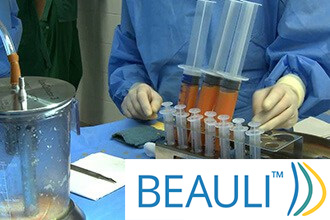
The treatment concept combines the gentle harvesting of autologous fat with its targeted transplantation into the breast. What matters is not only the liposuction itself: how the fat cells are handled during harvesting and transplantation, and how finely they are distributed within the tissue, are central elements of the procedure.
An idea from Birkenwerder: the history of autologous fat transplantation
As early as 1893 the successful transplantation of the body's own fatty tissue was reported. Prof. Neuber (Kiel, Germany) found that it succeeds when the smallest possible pieces of fat are distributed evenly in healthy tissue. These early findings were later disregarded: at times large amounts of fat were injected into a single site, so that results ranged from excellent success to failure – in the worst case leading to calcifications and oil cysts.
In March 2007 Dr. Coleman published a study on the results of breast augmentation with transplanted autologous fat in the Plastic and Reconstructive Surgery journal, the world's leading journal for plastic surgery. The examinations were carried out several years after the fat transplantation and document lasting success. Further publications (Illouz / Delay from France) confirmed these positive results.
There is a reason why contradictory information about autologous fat transplantation can still be found today: if the fat is injected directly into the breast through large cannulas, a large proportion of the cells die and release their contents. With larger clumps of fat, the body can no longer metabolise the pooled oil; it is encapsulated in tissue, can calcify and may become visible on X-ray images as an oil cyst. That is precisely why we gave our method its own name – so that it can be clearly distinguished from other procedures.

At the centre of the development stood the question of how fat cells can be harvested as gently as possible and used to build up the breast. One essential technical basis is water-jet assisted liposuction (WAL): the fat is released from the tissue with a fine jet of water. We have been using autologous fat transplantation at Park-Klinik since 2008; key steps in developing the harvesting technique were taken in our operating theatres in Birkenwerder.
Today the BEAULI™ method is used far beyond Birkenwerder – but its origin lies here. At Park-Klinik Birkenwerder near Berlin, the history of the method, many years of clinical experience, scientific work and the passing on of knowledge all come together in one place. BEAULI™ – the original from Birkenwerder.
Research, science and passing on knowledge
The technique has been accompanied by clinical studies from the very beginning. The first scientific publication on the BEAULI™ method appeared in 2010, and further publications followed. A selection to read:
- Ästhetische Brustvergrößerung mit Eigenfett nach der Beauli™-Methode
- Handchirurgie Microchirurgie Plastische Chirurgie – Beauli™ – eine neue Methode zur einfachen und zuverlässigen Fettzell-Transplantation
- Neue Langzeitstudie zur Brustvergrößerung nach der Beauli™-Methode
Doctoral theses have also examined the durability of the results – you will find more on this in our science section.
The strong demand for training and further education gave rise to the BEAULI™ academy (opens in a new tab) at Park-Klinik Birkenwerder, which international specialists attend to study autologous fat transplantation and WAL.
We do not only apply BEAULI™. We pass on the knowledge of a method that was developed in our own clinic.
What experiences have the patients had?
5.0 out of 5 · 4 reviews
