
Dr. med. Ursula Tanzella
Chief Physician and specialist in plastic and aesthetic surgery
At this location since 2000, Chief Physician since 2021, with an international reputation and leadership experience.
To the profileBreast surgery
The information given is for guidance only. The individual course of treatment and the total cost are determined in a personal consultation at Park-Klinik Birkenwerder near Berlin.
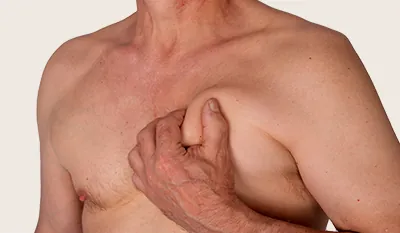
Gynaecomastia is a benign increase of glandular breast tissue in men. It can affect one or both sides. Fatty tissue is often deposited around the glandular body as well – even independently of body weight. This results in an enlarged male breast of varying degree.
Perhaps you would rather keep your T-shirt on at the swimming pool. Or you notice how much you think about your chest when exercising and getting dressed. An enlarged breast can weigh on your self-confidence. At our Park-Klinik Birkenwerder you can talk about it openly. We take your concern seriously and discuss with you what can be changed.
If the enlargement of the glandular tissue weighs heavily on you and other suitable treatments are not sufficient, a gynaecomastia operation at our Park-Klinik Birkenwerder near Berlin may come into question. In it, increased glandular breast tissue and, if necessary, excess fat are removed. The operation corrects the contour of the chest but does not automatically treat the cause. That is why a careful preliminary examination and a personal consultation always come first.
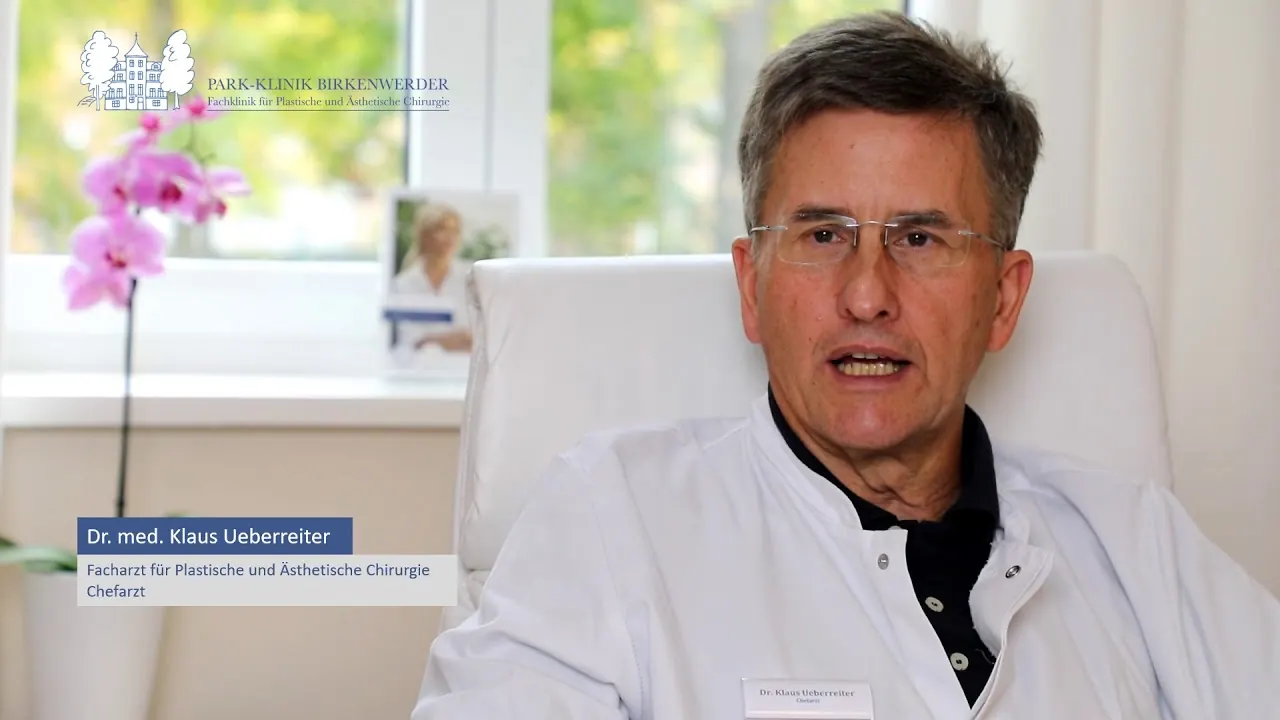
Dr. med. Klaus Ueberreiter, specialist in plastic and aesthetic surgery, explains whether there is an option for men to have the breast corrected.

You do not have to have an operation just because your chest deviates from a particular ideal. What matters is how you feel and whether a treatment makes medical sense. New lumps, a rapidly increasing enlargement on one side or changes to the nipple should first be examined by a doctor.
An enlarged breast can mean that you are constantly aware of your body – when getting dressed, when exercising or in your relationship. With us you can talk about it openly. We want to help you make a well-informed decision with which you can feel comfortable.

In true gynaecomastia the glandular breast tissue is increased. In lipomastia, also called pseudogynaecomastia, it is mainly the fat content of the breast that is increased. Often both occur in combination. The change can occur on one side or on both sides. We distinguish between these forms because they may require different treatments.
The first step is the personal conversation, the medical history. We ask about the onset and course of the breast enlargement, complaints, medication and other substances. Anabolic steroids or hormonal changes during puberty can also play a role. In pubertal gynaecomastia the change often regresses by itself. Whether further examinations are required depends on development and findings – not on a particular age limit alone.
When palpating, we check whether it is mainly glandular tissue or fatty tissue that is increased. Shape, size and skin conditions help us to assess the degree and to document changes over time. If necessary, an ultrasound examination supplements the examination.
Which additional examinations are necessary is decided individually. These can include blood tests with liver, kidney, thyroid and hormone values. An examination of the testicles and, if necessary, ultrasound can help to clarify hormonal causes. Further imaging or a genetic examination are arranged specifically if there are corresponding indications; they are not a blanket standard programme for every patient.
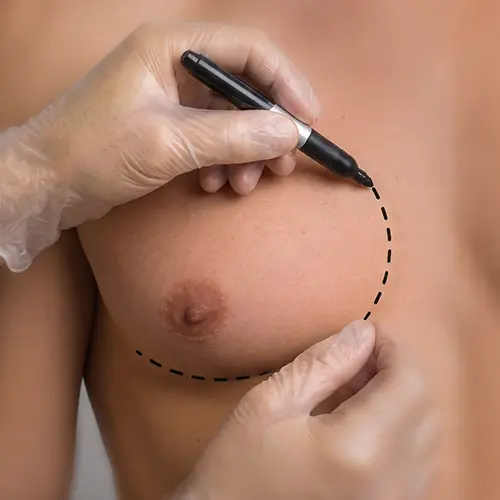
If fatty tissue predominates, liposuction can flatten the breast and harmonise the transitions to the upper body. Weight reduction can also help if there is corresponding overweight. However, firm glandular tissue cannot be reliably removed by training, losing weight or liposuction alone.
In true gynaecomastia, glandular tissue can be removed through an access at the edge of the areola; in medical terminology this procedure is called subcutaneous mastectomy. We often combine this with liposuction to shape the contour evenly. We show you which incision is required before the operation. Small accesses also leave scars; how inconspicuously they heal is individual.
With a pronounced enlargement or after greater weight loss, excess skin can remain. In that case, skin tightening may be necessary. We discuss openly which improvement is possible and which additional scars have to be accepted for it. The aim is a coherent contour; complete symmetry cannot be promised.
Yes. The treatment depends on the cause and on how long the change has existed. In temporary pubertal gynaecomastia, observation may initially be sufficient. If an illness or a medication is partly responsible, further treatment is coordinated with the doctors responsible. Please do not stop prescribed medication on your own.
Hormonal treatment comes into question only for selected findings under specialist supervision. Testosterone is not a general therapy for gynaecomastia and is considered only in cases of proven deficiency. Glandular tissue that has existed for a longer time often does not regress sufficiently with medication. If the breast enlargement continues to burden you significantly, we will discuss a surgical correction.
We listen: what bothers you about your chest, and what would you like to experience more freely in everyday life again? We then examine the breast and assess glandular tissue, fat distribution and excess skin. We explain the possibilities, limits, scars and costs to you. You are given time for your decision.
Before the operation you discuss the necessary examinations, your medication and the suitable anaesthetic method with the surgeon and the anaesthesia team. Please also tell us about over-the-counter painkillers and dietary supplements; some substances can affect blood clotting. You receive precise instructions on fasting, accompaniment and getting home. The operation can be performed under local anaesthesia or under general anaesthesia; we decide this together with you and the anaesthesia team.
Your operation is performed here by a specialist in plastic and aesthetic surgery. Depending on the findings, access is gained through a small incision in the area of the areola. Increased glandular tissue is removed and, if necessary, combined with liposuction; with greater excess skin, additional skin tightening may make sense. The procedure usually takes about 60–90 minutes; more extensive corrections can take more time. Renewed growth is possible despite the operation, particularly if triggering factors persist.
After the operation our team looks after you. Depending on the procedure and your personal situation, treatment is outpatient or with inpatient care. At the check-ups we monitor wound and scar healing so that abnormalities can be recognised and treated early. We discuss with you when everyday life, work and sport are possible again.

The breast may initially be swollen, tense and tender; bruising is also possible. Perhaps you would like to assess the result immediately. Give your body time: a first change is visible early on, while the final contour develops as the swelling goes down and the tissue continues to heal.
With us, compression garments are usually intended for about four weeks after the breast correction. They are meant to support the treated areas. How they fit and how long you wear them is something we discuss individually. The dressings stay on for about four weeks. For wound care and showering you receive a personal plan.
Your time off depends on how extensive the procedure is and what you do for a living. Physically heavy work requires different planning than office work. Sport, chest muscle training and heavy lifting are initially restricted and gradually increased after medical clearance.
Regular wound checks help us to recognise inflammation and conspicuous scar development early. Protect the fresh scars from friction and pulling, and follow our wound care instructions. Once the wounds are completely closed, we discuss further scar care. The scars mature over several months.
Medical photo documentation can help us to compare the initial findings, the change in contour and the course. It is part of the individual treatment documentation and not a promise of a particular result.
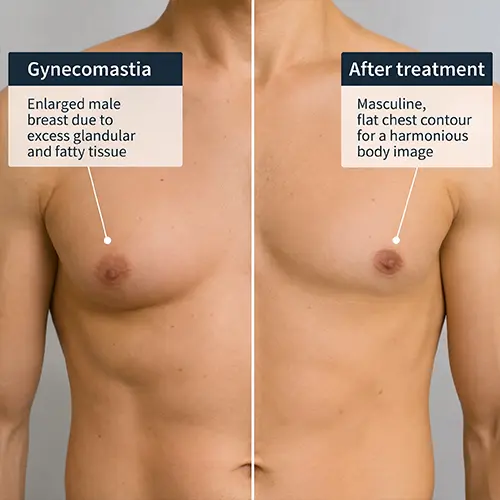
Indication for gynaecomastia
Our aim is a flatter, natural-looking chest that suits your upper body. How the contour develops depends, among other things, on skin quality, tissue distribution and healing. Weight fluctuations, hormones and persisting triggers can influence the result later. Renewed breast growth is also possible. We therefore talk not only about the operation but also about the conditions for a long-term satisfactory result.
After the operation, swelling, bruising and a feeling of tension can occur. Further risks are secondary bleeding, infections, wound healing disorders, conspicuous scars as well as changes in sensation or contour. Rarely, circulatory disorders of the nipple, up to tissue loss, are possible. We discuss your personal surgical and anaesthesia risks with you calmly.
If the breast swells rapidly after the operation, pain increases markedly, or fever or conspicuous changes to the wound occur, please contact us immediately. When you are discharged you receive information on whom to contact with questions or complaints.
Price incl. 19 % VAT, plus anaesthesia; inpatient stay depending on your personal treatment plan, shown in the quotation
A gynaecomastia operation costs from 3.900 € at our Park-Klinik Birkenwerder – including 19 % VAT and plus anaesthesia. The exact price depends on how much glandular and fatty tissue is treated and whether additional skin tightening is required.
Before you decide, you should know what to expect. After your examination you receive an individual cost estimate with the planned services and, if applicable, additional costs. You will find an overview of our treatments in the price list.
Yes, at Park-Klinik Birkenwerder near Berlin, regular aftercare after your gynaecomastia operation is already included in the agreed treatment price. This includes all planned follow-up appointments as well as additional interim check-ups – at no extra charge.
Because your care with us does not end with the operation. Our experienced specialists accompany you personally throughout the entire healing phase, monitor the healing process and are at your side with any questions or uncertainties. For your safety, optimal healing and a lastingly beautiful result.
A possible reimbursement depends on the medical indication, your insurance contract and the treatment in our private clinic. Please clarify reimbursement in writing with your insurer before the procedure. A general reference to medical necessity does not replace a specific commitment to pay.
The Park-Klinik Birkenwerder is a state-licensed private clinic according to § 30 GewO and does not bill statutory health insurance. If you wish to have the treatment carried out through your statutory health insurance, please contact an appropriately approved hospital already for the consultation.
Private health insurance companies can partially or fully cover the costs of a medically necessary treatment depending on the tariff. A written clarification should be obtained before the operation.
“Many men do not talk for a long time about how much their chest shape weighs on them. It is important to me that you feel taken seriously with your concern. Together we plan a treatment that suits your body and your wishes.”

Would you like to wear a T-shirt again without constantly thinking about your chest? Or first understand why your breast has changed? We take time for your questions and your personal situation. Together we discuss whether a treatment makes sense and which path suits you. Your treating specialists explain the procedure and the aftercare to you personally; you are also welcome to raise any uncertainties. Book your consultation at our Park-Klinik Birkenwerder near Berlin.
Chief Physician and specialist in plastic and aesthetic surgery
At this location since 2000, Chief Physician since 2021, with an international reputation and leadership experience.
To the profile
Deputy Chief Physician and specialist in plastic and aesthetic surgery
With many years of expertise and leadership experience in international and national institutions.
To the profileIf increased glandular tissue determines the shape of the chest, training alone cannot remove it. With excess fat, exercise and weight loss can help. We examine your chest and discuss whether liposuction, removal of glandular tissue or another treatment comes into question.
Yes. New changes on one side in particular should be examined.
The diagnosis describes a benign enlargement. Conspicuous findings must nevertheless be clarified specifically.
Training changes the muscles but does not remove increased glandular tissue.
With excess fat, weight loss can help. Glandular tissue does not reliably regress as a result.
Possible causes are hormonal changes, medication, anabolic steroids and certain illnesses. Sometimes the cause remains unclear.
That depends on your history and findings. An endocrinological assessment can make sense.
If the palpation findings are unclear or there are abnormalities, ultrasound can contribute to the diagnosis.
No. Observation or treatment of a cause can be sufficient.
In selected early cases, specialist drug treatment comes into question. It is not suitable for every form.
Only after careful assessment of development, course and burden. Waiting is often the sensible first step.
With predominant excess fat, possibly. Firm glandular tissue may require additional removal.
Often at the edge of the areola and at small liposuction access points. Skin tightening can require longer scars.
As a guide, about 60–90 minutes. More extensive corrections can take longer.
General anaesthesia is usually used. For limited procedures, local anaesthesia may come into question.
Depending on the extent, the treatment is performed as an outpatient procedure or with an inpatient stay.
With us, compression garments are usually intended for about four weeks. We adjust the duration to your procedure and your healing.
That depends on your job, the extent of the operation and healing. Physical work usually requires more rest.
Only after medical clearance. Chest muscle training and heavy lifting are increased particularly carefully.
A first change is visible early on. The result is assessed after the swelling has gone down and further healing.
Yes, particularly if triggering factors persist or recur.
Temporary and, rarely, lasting changes in sensation are possible.
from 3.900 € including 19 % VAT, plus anaesthesia. Your individual cost plan is decisive.
Coverage depends on the individual case and should be clarified in writing before the procedure.
Park-Klinik Birkenwerder is located directly on the northern edge of Berlin (Hubertusstraße 22, 16547 Birkenwerder) and can be reached from central Berlin in about 25 minutes. By car, take the A111 motorway (exit Stolpe/Birkenwerder) or the B96; by S-Bahn (lines S1 and S8) you can travel without changing from Berlin-Mitte, Friedrichstraße or Gesundbrunnen to Birkenwerder S-Bahn station. Quiet private rooms with 24-hour nursing care are available for overnight stays after gynaecomastia surgery.

Our experienced specialists in plastic and aesthetic surgery take the time for your wishes and questions. Book your consultation at Park-Klinik Birkenwerder near Berlin – for more well-being and quality of life.
Feel in safe hands.
Content medically reviewed by Dr. med. Ursula Tanzella, Specialist in plastic and aesthetic surgery
Last medically updated: